

Noise emissions from cooker hoods and household appliances – facts straight from the Ciarko laboratory
The noise produced by household appliances poses absolutely no risk to hearing. However, it can be annoying and may indeed be a nuisance at times.

admin
These days, noise levels have become a fashionable – if not one might say a favourite – parameter. For the time being, there are more myths than hard facts circulating on the market about ‘decibels’.
- Very often, the same sound wave (noise) is perceived differently by people. Some people don’t even notice it, whilst others find it irritating.
- The noise emission levels for household appliances, as recommended by the EU and stated on product labels, often differ in practice from the stated figures.
- The marketing race to achieve the lowest possible noise levels in household appliances is not only pointless but also impractical.
- Noise emission data is, in most cases, incorrectly stated in catalogues or on price labels.
- Reducing noise emissions from cooker hoods and household appliances is possible, but it requires expert knowledge and high-quality components.
Let’s start by noting that, in terms of noise emission, a cooker hood is a highly non-linear appliance. What does this mean? Firstly, it emits different noise levels under different conditions; secondly, this level depends on its operating modes. Note that the cooker hood emits the lowest noise level on the first, lowest fan speed. The situation is quite different when it is switched to intensive mode (i.e. the highest setting). But that’s not all.
Well, noise is a logarithmic quantity, so whilst the algebraic difference between 20 and 40 dB is merely ‘twenty’, in practice the noise emitted in this case is – wait for it – a hundred times louder in physical terms! But here’s an interesting fact and, at the same time, some reassurance: this does not mean that we will hear it as 100 times louder. Absolutely not. And this is the very nature of sound waves. Noise is an exceptionally ‘unruly’ and difficult-to-define phenomenon.
So how should we go about tackling the issue of noise in cooker hoods and household appliances in general?
Nowadays, disputes between manufacturers, retailers and consumers are becoming increasingly common. There have been extreme cases where such ‘problems’ have ended up in court. The manufacturer insisted that the appliance in question met the standards, the retailer pointed to the energy efficiency label stating the noise emission range, and yet the consumer refused to accept this, claiming that the appliance made it impossible not only to sleep but also to rest during the day.
This is a completely unnecessary dispute, stemming from a total misunderstanding of the issue of noise emissions and how they are perceived by humans and their senses. In practice, every appliance retested in a laboratory will show noise emission values that perfectly match those stated on the label. Why? Because it is tested in an anechoic chamber – under ideal conditions. There are no obstacles to the propagation of sound waves, and there is no background noise or echoes. In real life, however, a cooker hood or household appliance operates under completely different conditions. Very often, we ourselves (unwittingly) ‘amplify’ its noise level.
Remember: a faulty cooker hood design, incorrect installation, or wobbly kitchen cabinets – which might not seem to affect noise levels – can generate an ‘extra’ 10–15 dB, and sometimes much, much more!
It is worth choosing cooker hoods with relatively low noise levels – but this should not be the main deciding factor. Far more important is correct installation and the use of high-quality components and flue pipes. The same applies to washing machines. Few people realise that simply levelling the washing machine incorrectly or placing it on an unstable surface can lead to an increase in sound pressure and noise levels of 10 to 20 dB!
And although we’ll discuss this in more detail later on, it’s worth asking at this stage whether it’s worth chasing sales targets, or whether it might be better to provide proper training for sales staff?
How should one choose and recommend devices when noise is a key factor?
When choosing or recommending a cooker hood, it is advisable to stick to a single, clearly defined unit of measurement. Although this unit is specified as dB(A), it is not uncommon for other units of noise measurement to be listed on cooker hoods. Not only is this inconsistent with the EU Regulation on energy efficiency labelling for cooker hoods, but it is also misleading.
Take, for example, the ‘same’ noise expressed in two different units: 40 dB re 20 μPa (relative to micropascals) and 50 dB re 1 pW (relative to picowatts). The noise levels are similar, but the figures are different. At first glance, ‘40’ seems better. Well, not quite. In this case, that simply isn’t true!
Similar inconsistencies can, ironically, be found in many other categories of home appliances and audio-visual equipment. The most prominent example is audio equipment, where several power ratings are used – for example, 20 W (DIN), 35 W (RMS) and 120 W (PMPO).
Conclusion: above, we’ve listed the same power rating, but in different units. As you can see, 120 Watt PMPO is the ‘highest’ power rating and looks so impressive on the label. It really shows off its power, doesn’t it?
Yes, that’s true. It looks good, but that’s all it is. Measuring the peak power (PMPO) of an amplifier’s power amplifiers is good for the marketing and advertising departments. For the customer, however, this can only spell trouble, as the figure says little about actual power output; rather, it refers to the peak moment at which the speakers or the amplifier will burn out.
Sound pressure level (dB), A-weighting and the reference ‘re 1 pW’
When it comes to cooker hoods and domestic appliances, it is very important to establish a single standard for both testing and comparisons across different types of appliances. It’s a bit like the difference between a kilogram and a pound. A kilogram is actually just half a kilogram (0.45). We might be able to lift 200 pounds, but we certainly couldn’t lift 200 kilograms. And that doesn’t mean we’re any weaker.
Pamiętajmy: The misuse and manipulation of products is rife today and does no one any favours. Neither manufacturers nor retailers (incorrect information can lead to complaints), nor the customers themselves.
Now that we know where the problem lies, the noise level of cooker hoods is indicated by a formula containing the magic numbers and symbols ‘LWA’ and dB(A) re 1 pW. This “LWA” is nothing more than the sound pressure level measured in decibels (in the case of pascals, it is “P”) using an “A” weighting filter. The whole value is expressed in watts (in this case, pico-watts, i.e. 0.001 W).
At this point, it is worth explaining why we do not use a scale based on pascals. The reason for this is that the human ear is capable of detecting sound pressure as low as 2 × 10⁻⁵ Pascals (the so-called threshold of hearing), but also sound pressure of 200 Pa, at which a distinct pain is felt (the so-called pain threshold). As can be seen, the highest sound pressure level detectable by the human ear is 10,000,000 million times greater than the lowest.
For this reason, rather than using a linear scale and astronomical figures, a logarithmic relative measure was introduced, known as the sound pressure level expressed in watts.
The correct unit and its notation are as follows:
50 dB(A) re 1 pW
This formula can be interpreted as noise with an intensity of 50 decibels, measured using an A-weighted filter, relative to (from ‘re’ – reference) 1 picowatt.
Important! Let’s not forget that on the label for cooker hoods, noise levels are indicated by the abbreviation ‘LWA’ and are measured at the highest setting during normal operation of the hood.
The resulting value is then rounded to the nearest whole number. The precise methods and formulas for calculating noise emissions are set out in the relevant EC Regulation.
Where does the letter ‘A’ next to the decibel rating come from, and what does it actually mean?
Right, but what about that ‘A’ in brackets? Where did it come from and what is it for? Well, it is a type of filter used in measuring equipment. Incidentally, there are also ‘B’ and ‘C’ filters, but when testing noise levels for the human ear, only the ‘A’ filter is used. This is because it minimises the subjectivity and certain limitations of the human ear.
To give an example: a sound with a frequency of 100 Hz (so-called ‘low’ tones) and a sound pressure level of 60 dB will be perceived as 10 times quieter than a sound with a frequency of 1,000 Hz (‘high’ tones) and the same sound pressure level of 60 dB. That is precisely why these ‘squeaks’ make our lives so miserable…
Two groups of people affected by noise: those who are not very sensitive to it and those who are particularly susceptible to it
In the previous section, we explained why we use the ‘A’ filter and why it is important from the perspective of human hearing physics. But there is also a psychological aspect to it.
Well, although the noise level will be the same, for some people the sound of a hammer striking won’t be as irritating as the whirring of a washing machine or the hum of a cooker hood. Others will be able to put their children to sleep with the cooker hood on its lowest setting (yes, really!), whilst on turbo mode, their husband will be leaving the kitchen. Here, unfortunately, we’re entering the particularly tricky territory of how sound is perceived. People who are hypersensitive may have a problem not only with a neighbour walking out to work in high heels, but the noise generated by household appliances, coming from the kitchen or bathroom, may also get on their nerves.
As if that weren’t enough, some people are sensitive to low frequencies, whilst others are sensitive to high frequencies. Each of us also perceives sounds in a completely different way. Hence, for some, the sound of a dog barking in the distance may be unbearable, whilst others may not even ‘notice’ it (they may hear it, but pay no attention). Unfortunately, genetics is responsible for this, rather than faulty household appliances or a mischievous mongrel.
Examples of noise levels in cooker hoods:
- Up to 40 dB(A) – very low,
- 40 to 50 dB(A) – low,
- 50 to 60 dB(A) – moderate,
- 60 to 70 dB(A) – loud,
- Above 70 dB(A) – very high.
Noise levels and cooker hood operating modes (example):
- First gear – approx. 40–50 dB(A),
- 2nd gear – approx. 50–60 dB(A),
- 3rd gear – approx. 55–65 dB(A),
- 4th gear – approx. 65–75 dB(A).
How to reduce noise: a few simple everyday tips
First and foremost, buy high-end appliances from reputable manufacturers. When it comes to cooker hoods, the so-called compactness of the unit, the acoustic design of the interior, and the components and assembly used are of paramount importance.
Unfortunately, there is still a group of manufacturers on the market who produce cooker hoods of dubious quality, or use substandard components, often skimping even on key parts such as the fan – the very heart of the cooker hood. It happens that the cheapest hoods not only lack properly shaped blades but also have a limited number of them. It’s always cheaper that way. Sometimes the metal panel isn’t tightened properly because they’ve skimped on a screw, or there’s no time, no idea and no resources for proper soundproofing. As a result, the hood is ‘quiet’ on paper, but it’s unbearable to have it running at home.
Conclusion: So let’s look not only at the energy efficiency label, which includes the noise level, but also at the brand, the quality of the cooker hood, and the experience and reputation of the manufacturer or brand.
Let’s also remember that there are no completely silent household appliances. On the other hand, very often it is not so much the appliance itself that emits noise, but the environment in which it is placed. This environment contains vibrations associated with the operation of individual components or the installation itself. These vibrations are the direct cause of the noise. Vibrations in household appliances in general can be caused by individual components of a given structure striking one another, rolling against one another or friction – i.e. mechanical causes, or causes of an aerodynamic or hydrodynamic nature (disturbances in the flow of liquid or gas through pipes, the expansion of liquid or gas, the formation of vortices, etc.).
It is therefore worth opting for modern ceiling-mounted or external-motor cooker hoods, which can reduce noise levels in the home to virtually zero. When it comes to installing and fitting domestic appliances, we should always choose professionals with the relevant knowledge and experience.
In sum: The extremely important level of noise emission in a hood depends on its quality, the use of high-class components and correct installation, which in the case of Ciarko are never an economic or marketing compromise.
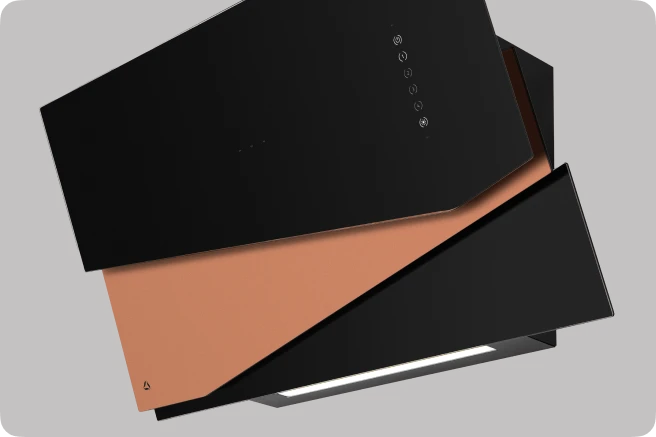
Stylish design: top-class design of Ciarko cooker hoods
The modern kitchen is no longer just a place for preparing meals. Today, it is the heart of the home. Today, it is the heart of the home.
Find out more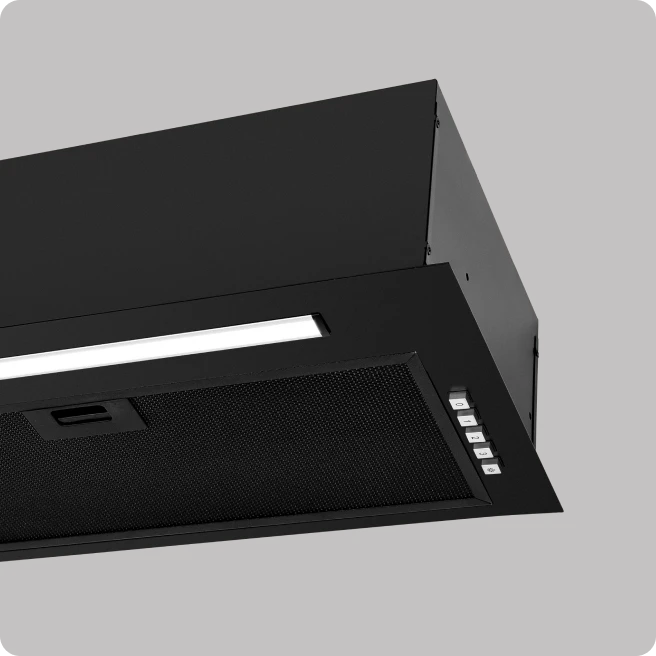
Installation guidelines for Ciarko cooker hoods for architects and designers
A good kitchen design is not just about aesthetics and ergonomics, but also about the proper integration of appliances, which must ensure safety and ease of use.
Find out more
Efficiency or power? Which is more important when choosing a cooker hood, not just a Ciarko?
Ciarko has been designing and manufacturing cooker hoods for 35 years. We combine precision with quality, durability and ease of use.
Find out more