

Efficiency or power? Which is more important when choosing a cooker hood, not just a Ciarko?
Ciarko has been designing and manufacturing cooker hoods for 35 years. We combine precision with quality, durability and ease of use.

admin
During this time, we have learned that one of the most common questions from customers and designers is: when choosing a hood, should we focus on the power of the device or its efficiency?
- Power and efficiency are two different but closely related operating parameters of a hood.
- Power alone does not guarantee effectiveness, because what counts is how effectively energy is converted into airflow.
- The quality (efficiency) of operation is determined by aerodynamics, duct design and engine type.
- Modern Ciarko BLDC motors ensure high efficiency and quiet operation with low energy consumption.
- Ciarko technologies such as AdaptFlow and SilentTech guarantee the best efficiency in everyday use.
These two parameters are closely related, but have completely different meanings. Properly understanding them is key to choosing a device that will effectively remove fumes and odors while operating quietly and economically.
Power and efficiency – similar concepts, different meanings
Efficiency determines the volume of air a hood can move in a given time. It's usually given in cubic meters per hour (m³/h). This parameter determines how effectively the device purifies the air.
Power this is the amount of electrical energy consumed by the motor to operate. It tells us how powerful the drive is, but it doesn't tell us how effectively this energy is converted into air movement or the extent of the air being purified.
Attention: the motor power should not be confused with the connected power of the entire hood. The latter, in addition to the fan, also includes the hood's controls and lighting.
At Ciarko, from the very beginning of designing a new model, we've been striving for a balance between power and efficiency. Because high power is pointless if it doesn't translate into actual airflow. Furthermore, it impacts operating costs and energy efficiency ratings. High performance won't be sustainable or effective if it requires constant operation at the engine's limits.
Why Power Alone Isn't Enough
It's a common myth that "the more power, the better the hood." Almost as many people think about car engines. In reality, power is only potential, not a guarantee of effectiveness, and therefore actual efficiency.
In practice, the quality of the hood's operation is determined by:
- interior aerodynamics – the better the design of the duct and inlet system, the more effectively the hood will use the engine power,
- installation resistance – long or winding ventilation ducts, narrowings, elbows, sharp angles can reduce the flow by up to 30-40 percent,
- type of engine used – a traditional high-power brushed motor may be less efficient than a modern, brushless BLDC motor that is half as “weaker” but almost twice as efficient,
- assembly quality – leaks, improper pipe sealing or too small a duct cross-section may in practice reduce the effectiveness of even the most powerful device.
That's why at Ciarko, we don't design hoods "by watts." Instead, we focus on efficiency, meaning how power actually translates into airflow, low noise, and energy consumption.
Hood efficiency and its real ranges, and actual effectiveness in everyday use
Efficiency is a parameter that the user immediately notices. It determines whether the kitchen will remain smelling of fried fish or braised onions after cooking, or whether the air will be clean in just a few minutes.
Standard hood capacity is measured in cubic meters per hour (m³/h). For small kitchens, 300-400 m³/h is sufficient, for medium-sized and open-plan kitchens, 500-800 m³/h, and for large spaces connected to the living room, even 900-1000 m³/h or more.
The once-accepted rule that a hood should exchange air 6 to 12 times per hour (depending on its operating mode), the volume of a room measured in cubic meters, while theoretically accurate, is difficult to measure in practice. We're dealing with kitchens open to the living room, vertical and ceiling hoods, for example. The dynamics of their operation and the physics of airflow in such conditions are completely different from the classic wall-mounted or island "T" hood, which is "enclosed" within a single body, the starting point for these calculations. Incidentally, an over-capacity hood in a kitchen connected to the living room or in a single-family home can draw large masses of air from other rooms and floors, including cold air, and disrupt air circulation throughout the house.
It's worth noting that our adopted ranges are based on performance tests conducted in conditions similar to those of real-world installations. This ensures that the data in our catalogs reflects the appliance's actual performance in the kitchen.
It is also worth remembering that the nominal (laboratory) efficiency is not the same as the operational efficiency, which is influenced by:
- the length of the channel and its shape,
- number of filters and their proper maintenance,
- operating mode: absorber/extractor (recirculation),
- temperature and air pressure in the room.
Taking the above into account, this is why we use AdaptFlow technology in Ciarko hoods, which automatically compensates for flow losses in absorber mode, increasing efficiency by up to 20 percent.
In sum: high power doesn't mean high efficiency. The quality of a hood's performance is determined by how the design and aerodynamics translate the engine's energy into actual airflow.
Where power ends and efficiency and comfort of use begin
Considering everything we've said so far, power in a hood shouldn't be the goal in itself. An oversized motor can lead to increased noise, vibration, and higher energy consumption, not necessarily better cooking results.
In practice, the idea is for the engine to have enough power to maintain stable performance in all conditions, including dirty filters, recirculation mode or a longer ventilation duct.
That's why Ciarko uses BLDC (brushless) motors, offering high efficiency, smooth speed control, and very low energy consumption. In typical operation, a hood with a BLDC motor consumes between 8 and 30 W, translating into real savings over the course of a year.
The power control method is also important. In many Ciarko models, the GestureControl function allows you to change the hood speed with a simple hand movement, without touching the control panel. As a result, users are more likely to use higher power modes when truly necessary, which has a direct impact on efficiency and workflow.
Efficiency and acoustic comfort
Quiet operation is a key requirement these days. An overly powerful motor without adequate soundproofing often causes users to reduce speed or turn off the hood during conversations or meals. As a result, efficiency drops, even though the device boasts excellent performance on paper.
At Ciarko, we have been investing in noise reduction technologies for years:
- vibration isolators that minimize the transmission of vibrations,
- optimized rotor shape,
- housings with echogenic properties,
- flow suppression systems.
This means that even at maximum speed, the noise level of many Ciarko models does not exceed 65 dB(A), and at low speeds it drops to around 40 dB(A), which is theoretically equivalent to the noise of a computer fan. In practice, it is almost inaudible on a daily basis.
How Ciarko Combines Power and Performance in Practice
Design solutions developed in our factory allow us to maximize the engine's potential without over-inflating its power. This is why our hoods achieve high efficiency with low energy consumption.
In this respect, it is worth getting to know Ciarko's key technologies:
- BLDC motors – brushless, energy-saving and extremely durable,
- AdaptFlow – automatic adjustment to the operating mode (recirculation/extraction),
- CFD Flow Design – air flow simulations in the design process,
- SilentTech vibration isolation – noise and vibration reduction,
- AMS Modules – possibility of expanding the device with additional functions (sensors, control, plasma filters).
– possibility of expanding the device with additional functions (sensors, control, plasma filters).
When efficiency comes first
In most cases, efficiency should be the priority. It's worth considering when the kitchen is connected to the living room, intensive cooking occurs, there are high ceilings or large rooms, the ventilation system is extensive or has limited flow, or the hood operates in recirculation mode.
In such conditions, too low efficiency will mean that fumes and odors will not be removed effectively, even with a powerful engine.
When is it worth having a power reserve?
Power becomes crucial when the hood is to serve larger spaces, when a quick effect is needed (boost mode), or when the ventilation system generates significant resistance. The additional power reserve also allows for maintaining high efficiency despite gradual filter wear or changes in kitchen design.
In the Ciarko, having extra power doesn't mean wasting energy. Thanks to smooth regulation and intelligent control, the engine uses exactly as much power as needed at any given moment.
Summary
To the question "efficiency or power?" the answer is: efficiency, but only if the power has been well selected and is used effectively.
At Ciarko, we've been designing hoods for years to maximize their efficiency in real-world conditions. Thanks to modern BLDC motors, the AdaptFlow system, CFD flow simulations, and vibration-dampening design, our devices deliver the essentials:
- effective removal of fumes and odors,
- quiet and stable operation,
- low energy consumption,
- long service life of components.
Because in a well-designed hood, power and efficiency do not compete with each other, but create a harmonious system in which technology serves everyday comfort.
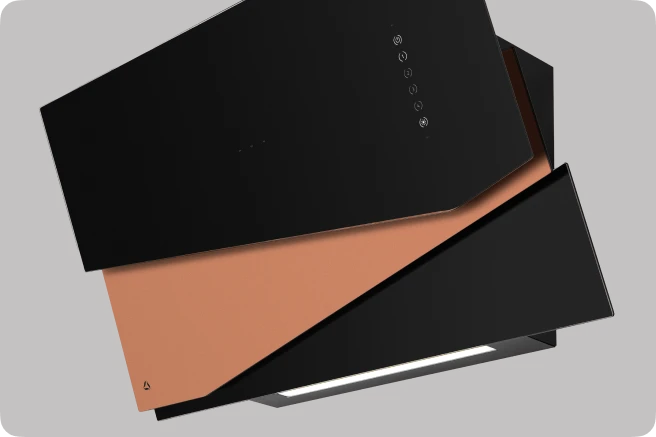
Stylish design: top-class design of Ciarko cooker hoods
The modern kitchen is no longer just a place for preparing meals. Today, it is the heart of the home. Today, it is the heart of the home.
Find out more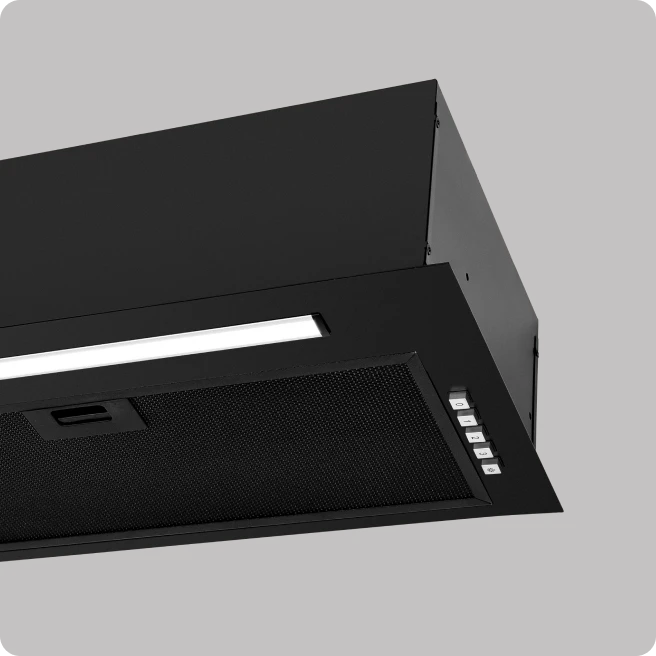
Installation guidelines for Ciarko cooker hoods for architects and designers
A good kitchen design is not just about aesthetics and ergonomics, but also about the proper integration of appliances, which must ensure safety and ease of use.
Find out more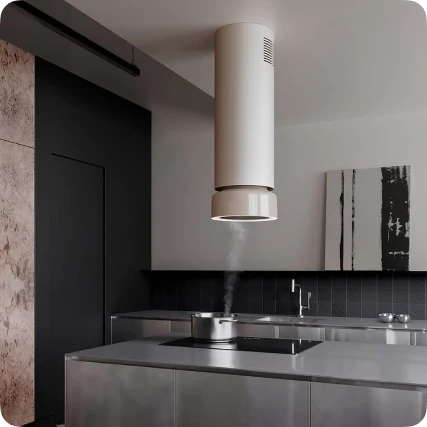
Noise emissions from cooker hoods and household appliances – facts straight from the Ciarko laboratory
The noise produced by household appliances poses absolutely no risk to hearing. However, it can be annoying and may indeed be a nuisance at times.
Find out more